
In my previous post, “Why Most SMB Websites Fail in 5 Seconds,“ I discussed how first impressions can determine whether visitors stay on a website or leave immediately.
However, there is another problem I frequently see when working with businesses. Even when a website has strong branding, clear messaging, and a professional design, it still struggles to generate leads and sales.
The reason is simple: people cannot buy from a business they cannot find. 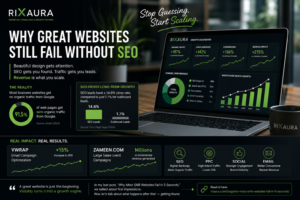
This is where Search Engine Optimization (SEO) becomes critical.
One of the biggest takeaways from my learnings and experiences is that SEO is not simply about adding keywords to a website. Search engines evaluate multiple factors to determine which websites deserve visibility. They look at relevance, authority, user experience, content quality, and technical performance when deciding where a website appears in search results.
For small and medium-sized businesses, this creates both a challenge and an opportunity.
Many business owners invest heavily in building a website but spend very little time understanding how their customers actually search online. We emphasizes the importance of keywords and search intent. In practice, this means businesses should focus less on what they want to say and more on what potential customers are actively searching for.
For example, a marketing agency may want to promote “integrated growth solutions,” but a business owner is more likely searching for terms such as “marketing consultant near me,” “lead generation services,” or “how to get more customers online.” Understanding this difference is often what separates websites that attract traffic from those that remain invisible.
Another concept from my experience that stands out is the relationship between user experience and search performance. Search engines want to provide users with the best possible results. Websites that load slowly, are difficult to navigate, or are not mobile-friendly often struggle to rank effectively. This reinforces the point made in my previous post: a website’s design and functionality are not just branding elements; they directly impact discoverability and performance.
At Rixaura, I view SEO as a long-term growth strategy rather than a one-time task. Effective SEO combines keyword research, optimized content, technical website improvements, and a strong user experience. When these elements work together, businesses increase their chances of appearing when potential customers are actively looking for solutions.
The reality is that having a great website is only half the battle. The other half is ensuring the right audience can find it.
Businesses that understand and apply SEO principles position themselves to generate more organic traffic, attract qualified leads, and create sustainable growth over time. In today’s digital environment, visibility is not optional. If your customers are searching online, your business needs a strategy that helps them find you before they find your competitors.