

Disconnect And Kill the Growth
Most startups and SMBs collect data, but don’t connect it. They’ll track “traffic,” celebrate “engagement,” and still wonder why sales feel inconsistent. It’s a connection problem, not a marketing effort problem. If data doesn’t change what you do next, it’s not performance, it’s just numbers.
Data Is Useless Until It’s Tied to a Customer
Here’s the shift marketing professionals make when they start scaling outcomes: they start looking at customer behavior and stop looking at channels. Instead of “Instagram is doing well,” the question becomes: Which customer type is coming from Instagram, what are they doing on the site, and do they convert profitably? Your best data is what people “do” and not what people “see.”
The Simple Connection Model
This is the cleanest way to link data → customers → performance without drowning in dashboards:
- Signal (Data): clicks, time on page, form starts, add-to-cart, replies
- Meaning (Customer): intent level, pain point, segment, stage in journey
- Outcome (Performance): conversion rate, repeat purchase, CAC, LTV
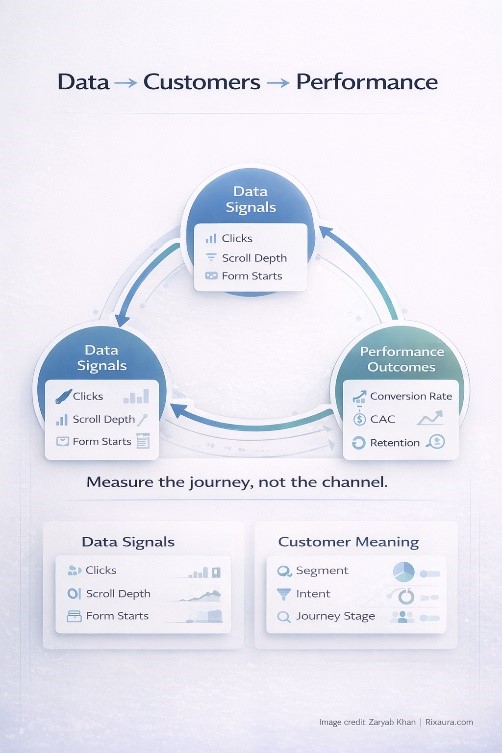
When all these three layers are connected, marketing stops being “content + ads” and becomes a system: you learn what attracts the right people, what convinces them, and what keeps them.
My Rulebook for SMB Teams
Here’s the principle I use with SMB clients: Measure the journey, not the channel.
Customers are the destination. Channels are just roads. If a campaign brings leads but they don’t close, that’s not “more budget”, that’s a mismatch: wrong segment, wrong landing page, wrong promise, or wrong follow-up. The fastest way to improve performance is to find where the journey breaks down, then fix that one break.
The Weekly Loop for Growth
To keep this practical, here’s a simple weekly routine that connects everything:
- What did customers do? (top actions + drop-offs)
- Which customer type did it? (segment/source/intent)
- What did it cost? (CAC / cost per lead)
- What changed this week? (one test to run next)
That’s how marketers connect customer reality to data and turn “marketing activity” into performance you can predict.
Topic: How Marketers Connect Data, Customers, and Performance